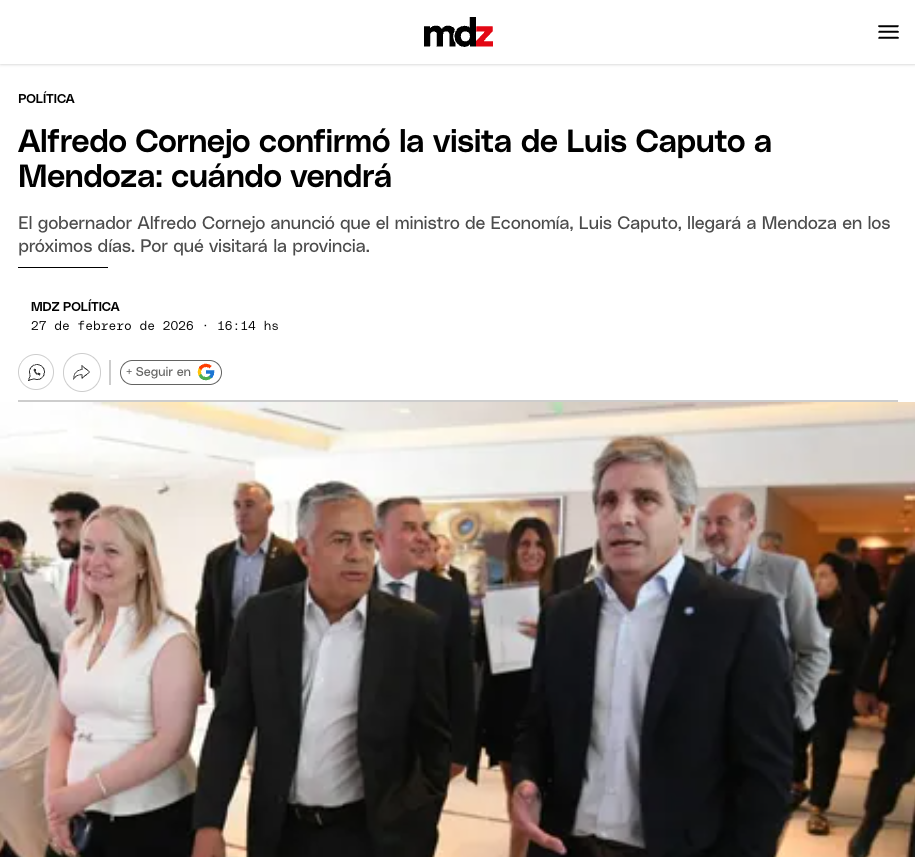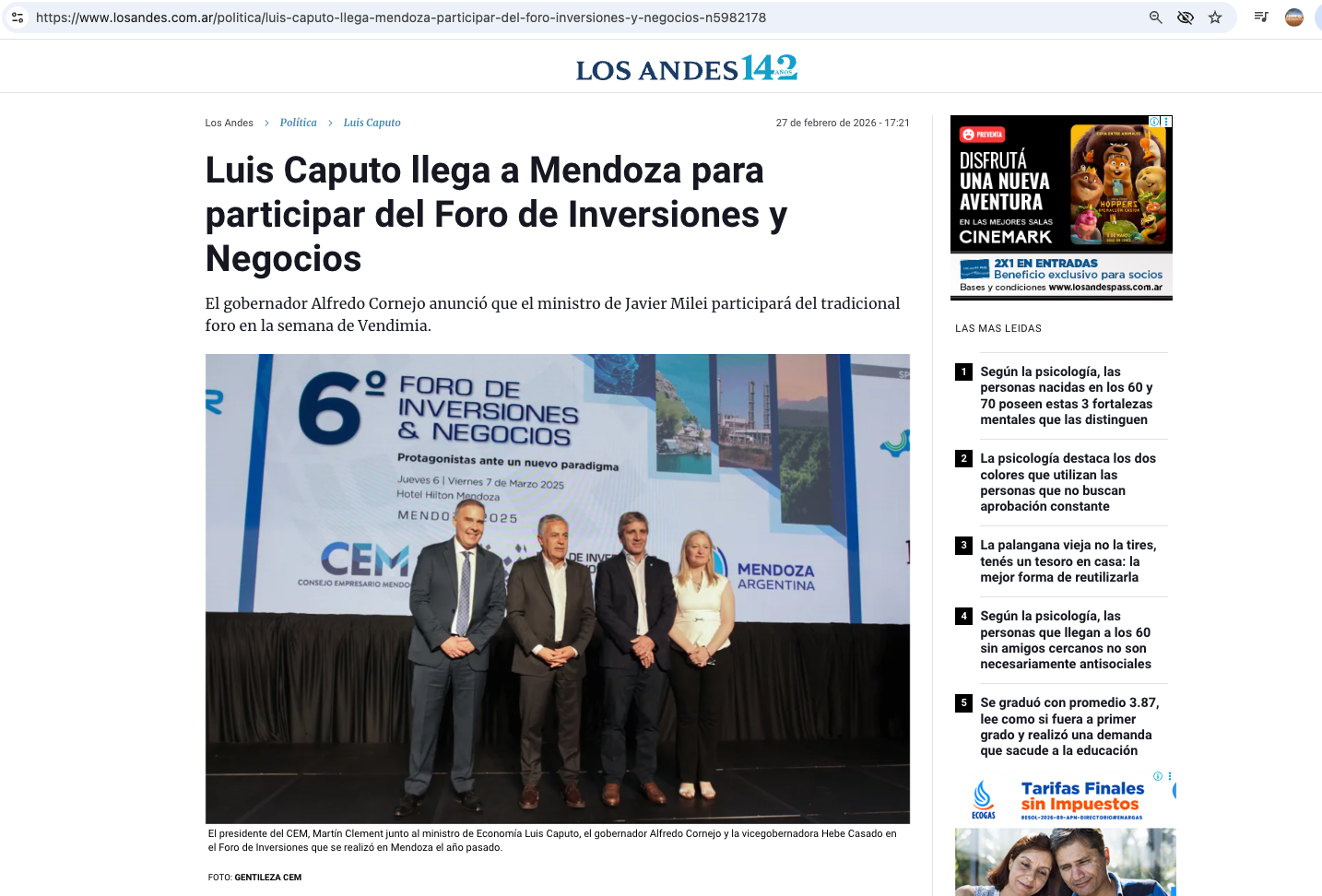

The third edition of the Mendoza Investment Forum took place, organized by the Mendoza Business Council (CEM) and the Provincial Government. The event featured the Governor, Alfredo Cornejo, and the National Minister of Production and Labor, Dante Sica, who highlighted the Forum’s impact in generating success stories through concrete investments.
“We are working to lower the ‘Argentine cost’ and improve the country’s competitiveness. To achieve this, we believe the process of opening up to the world is key; our goal for 2030 is to have more than 50,000 exporting companies. In this sense, Mendoza is a model of success. It is the province that grew the most in exports last year, nearly 13%,” Dante Sica stated during his opening speech.

Furthermore, the Minister announced a bill to provide tax benefits to companies within the knowledge industry: “They are the economy of the future. This sector generated nearly 40,000 genuine jobs last year and has already become our country’s third-largest exporting bloc.”
The welcome address was delivered by Javier Allub, President of CEM, who stated: “In Mendoza, business plays a vital role, and we need the National Government to support the private sector with foreign, tax, and labor policies that drive our country’s competitiveness. We must transcend changes in government by strengthening the synergy between the public and private sectors to ensure long-term development. The Mendoza Investment Forum has convincingly demonstrated everything that can be achieved to lead our province toward the future.”
Governor Alfredo Cornejo maintained that “Argentina is struggling to build a healthier economy, which is what we have needed for years. It is a long process and does not belong to a single administration. From Mendoza, we contribute to this goal by making decisions and executing concrete plans: we have balanced our budget and optimized public services,” adding, “If Argentina grows, Mendoza will grow even more.”
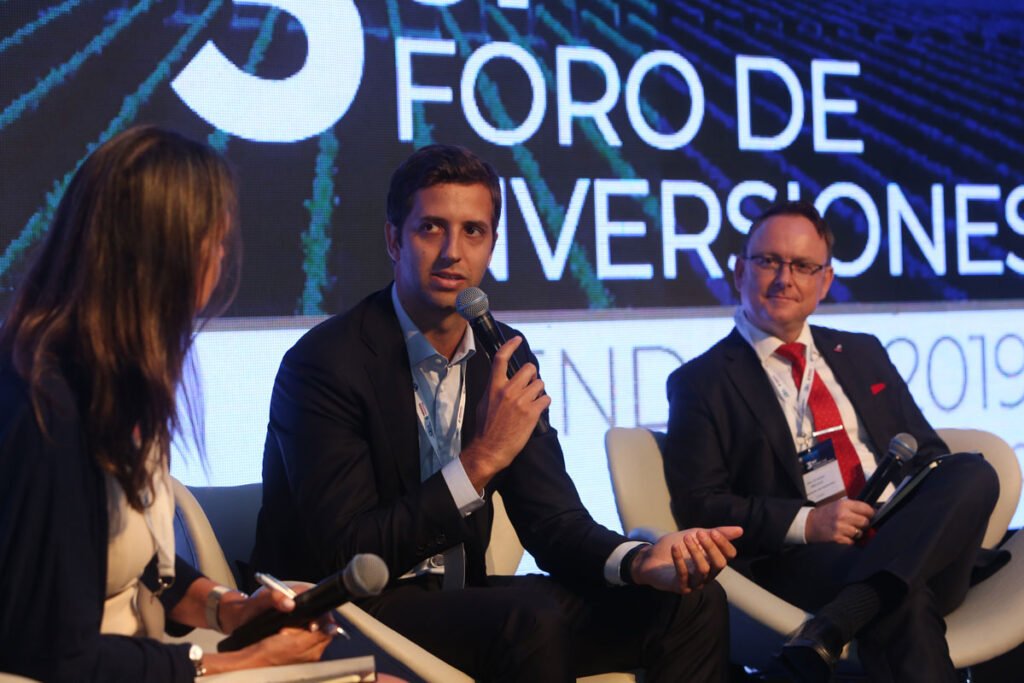
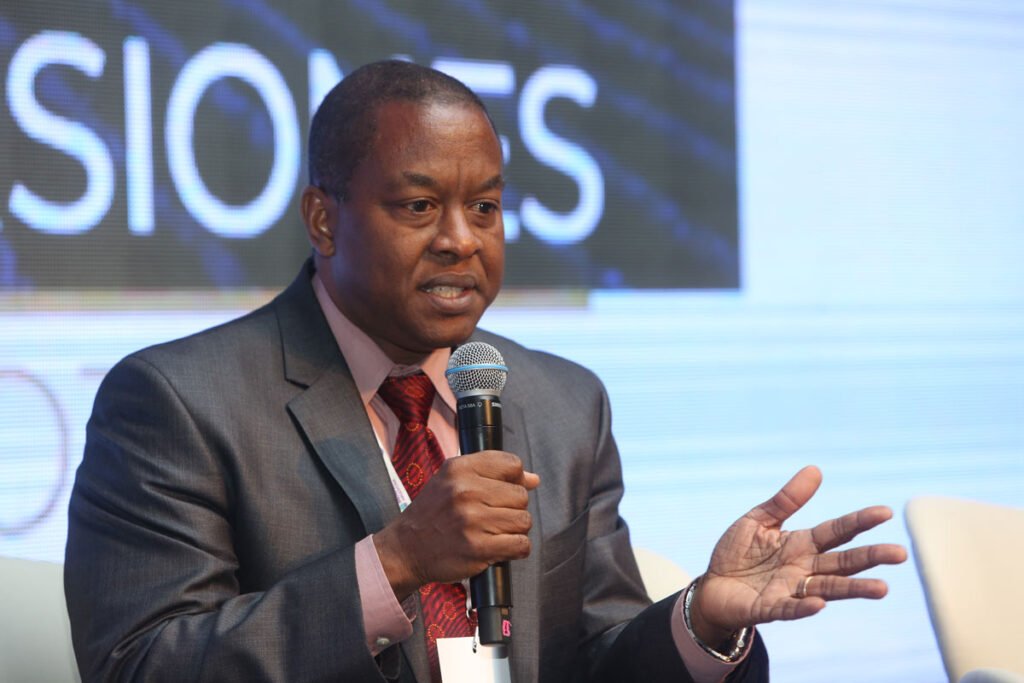
Trevor Alleyne, the International Monetary Fund (IMF) Representative in the country, participated in a one-on-one session with Sonia Ruseler, a journalist from the BBC in London, noting: “Member countries always have the right to call the Fund if they need help facing a difficult macroeconomic situation. However, the most important thing for us is when a country and its authorities demonstrate will and ownership over their economic plan. This component is the most critical factor for the success of a support plan.” Regarding the agreement with Argentina, he pointed out: “When the Argentine government approached the Fund with a firm plan and commitment, it was a very important signal for aid to be granted,” and assured: “There are times when a program must be recalibrated, and in the Argentine case, it was the government that proposed changes to the plan—changes which, in our view, were very serious, solid, and positive.” He also highlighted the cases of neighboring countries such as Chile and Peru, “where the commitment to resolving macroeconomic imbalances was very firm and enabled their current economic growth.”
During the panel “Driving Mendoza Through Venture Capital and Private Equity Investments,” moderated by Valentina Terranova (General Partner at Embarca), the debate featured Luis Bermejo (Co-founder and Managing Partner of Alaya Capital Partners), Francisco Coronel (Co-founder of NXTP Labs and VP of Seed Capital at ARCAP), and Juan Lucena (Managing Partner of Alba Capitals).
Later, two success stories were presented by companies that had participated in previous Forums and invested in the province: Felipe Aramburu, CEO of UBER Argentina, and Ole Christian Melhus, CEO of Norwegian Air Argentina. Francisco Uranga, Director General of the Argentina Investment and International Trade Agency, also participated in the discussion.
As part of the Forum’s activities, sectoral investment roundtables were coordinated, involving more than 200 business leaders, 35 government officials, and 30 CEM representatives. Additionally, on the previous day, 50 pre-scheduled meetings were held between investors, entrepreneurs, business owners, and government officials. Javier Allub and Pablo Puerino, President and Vice President of CEM, served as hosts.